How to Rank Your Local Business on ChatGPT and AI Search (2026)
When someone asks ChatGPT for the best plumber, dentist, or restaurant in your town, the answer comes from a small set of local data sources. Here is exactly what AI engines read for local recommendations, the seven levers that decide who gets named, and a 30-day plan any local business can run.

- 01How do ChatGPT, Gemini, and Perplexity choose local businesses to recommend?
- 02Lever 1 — A complete, active Google Business Profile
- 03Lever 2 — Reviews that say what you do and where you do it
- 04Lever 3 — Citation consistency across the local data ecosystem
- 05Lever 4 — A website that answers local questions in extractable form
- 06Lever 5 — LocalBusiness schema that disambiguates everything
- 07Lever 6 — Local corroboration an AI can verify
- 08Lever 7 — Bing indexation, because ChatGPT reads Bing
- 09What should a local business do in the first 30 days?
- 10How long does it take for a local business to show up in AI answers?
- 11Local AI ranking FAQ
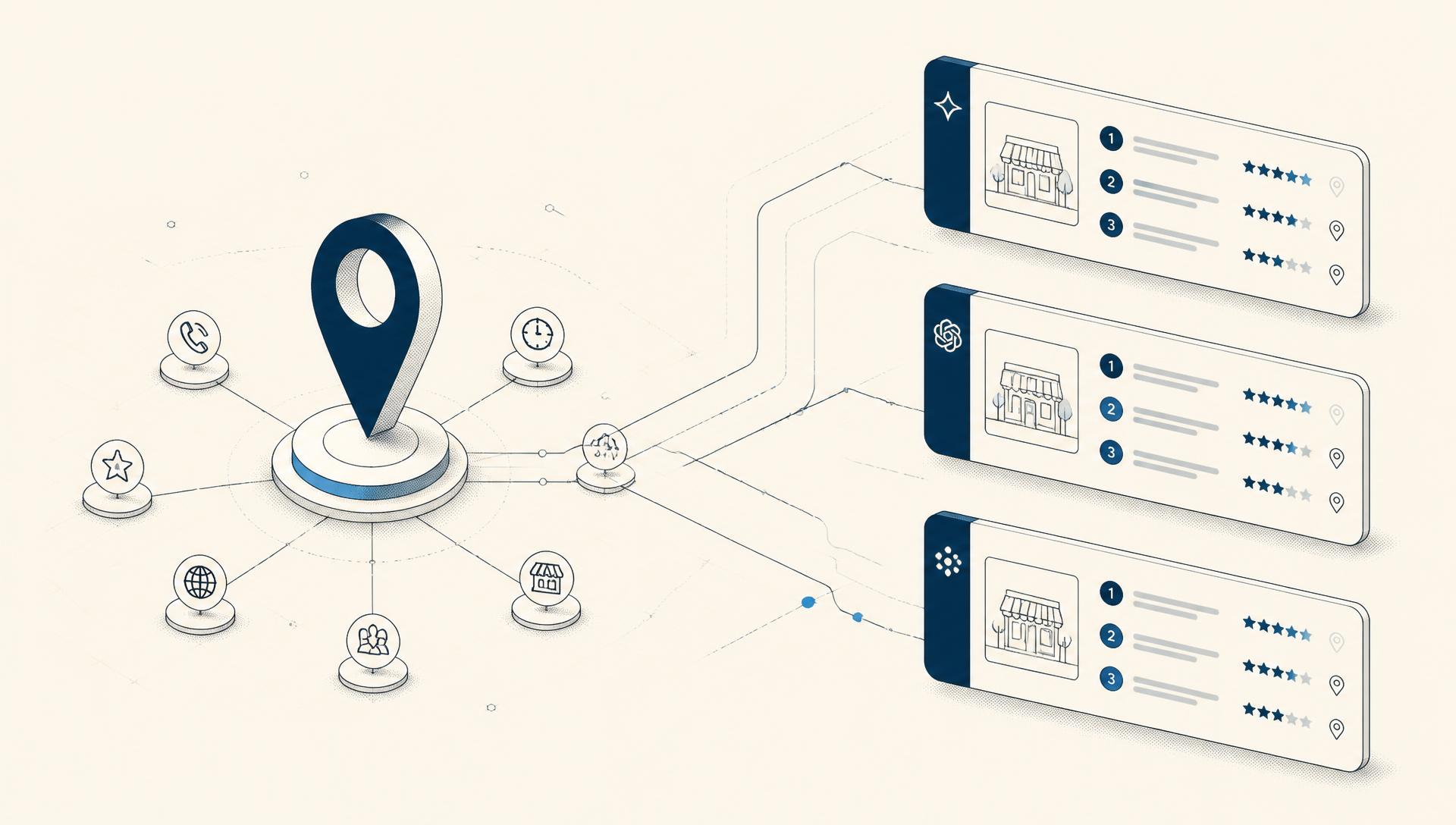
Local search is quietly moving from a list of ten blue links to a single spoken answer. When a homeowner asks ChatGPT 'who is the best roofer in Austin?' or a traveler asks Perplexity 'where should I eat near downtown Denver?', the engine names two or three businesses — not twenty. There is no page two. Ranking a local business on AI sites is therefore a different game from classic local SEO: instead of competing for position on a list, you are competing to be one of the few names an AI is confident enough to say out loud. That confidence comes from a small, knowable set of sources — your Google Business Profile, your reviews, your citations, your website's structure, and how consistently the whole web describes you. This guide covers what each AI engine actually reads for local recommendations, the seven levers that decide who gets named, and a 30-day order of operations.
How do ChatGPT, Gemini, and Perplexity choose local businesses to recommend?
Each engine assembles local answers from a different stack. ChatGPT with browsing leans on Bing's index, so Bing Places, Bing-ranked pages, and Bing-ingested reviews carry real weight. Google Gemini and AI Overviews draw directly on Google's local index and your Google Business Profile — categories, reviews, photos, and Q&A. Perplexity re-crawls live sources per query and cites four to eight of them, heavily favoring review platforms, local news, and well-structured business pages. Claude retrieves through its own crawler and favors credible, specific sources. What all four share: they name businesses they can verify across multiple independent sources, with consistent name, address, phone, category, and service details. One strong profile or one good page is never enough — the answer is assembled from the pattern across all of them.
Lever 1 — A complete, active Google Business Profile
Your GBP is the single most-cited local entity record in AI answers. Fill every field: primary and secondary categories, full service list with descriptions, service area, hours including holidays, attributes, and booking or menu links. Post weekly — updates, offers, seasonal services — because an active profile signals a living business. Answer every Q&A question yourself before someone else does, phrasing questions the way customers actually ask ('Do you offer emergency service on weekends?'). Add fresh photos monthly; profiles with recent, high-quality photos correlate with stronger local visibility across both traditional and AI-driven results. Pass test: search your business name on Google and confirm the knowledge panel shows complete data with no 'Suggest an edit' gaps.
Lever 2 — Reviews that say what you do and where you do it
AI engines read review text, not just star counts. A five-star review that says 'Great service!' teaches the model nothing; one that says 'They replaced our water heater in two hours — best plumber in Round Rock' directly feeds answers to 'best plumber in Round Rock'. Build a review program that asks at the moment of peak satisfaction, on the platforms AI engines read: Google first, then Yelp, Facebook, and the vertical platform your category runs on (Avvo for lawyers, Healthgrades for doctors, TripAdvisor for hospitality, Houzz for contractors). Respond to every review with the same descriptive specificity — 'Thanks for trusting us with your kitchen remodel in Cedar Park' reinforces entity, service, and location in one sentence. Never buy or gate reviews; engines discount suspicious patterns and platforms penalize them.
Lever 3 — Citation consistency across the local data ecosystem
Models hedge when sources disagree — if Yelp says 'Main Street' and your site says 'Main St.', if one directory shows an old phone number, the safest answer is your competitor. Lock one canonical NAP (name, address, phone) and replicate it exactly across Bing Places, Apple Business Connect, Yelp, Facebook, Nextdoor, the Better Business Bureau, your local chamber of commerce, and the top ten directories in your category. Fix every variation: abbreviations, suite formats, old numbers, duplicate listings. This is unglamorous work, and it is one of the highest-leverage moves in local GEO because it removes the contradictions that cause engines to skip you entirely. Pass test: search your phone number and business name, open the first fifteen results, and confirm every listing matches your canonical record character-for-character.
Lever 4 — A website that answers local questions in extractable form
AI systems retrieve passages, not pages. Build a dedicated page for each service in each area you serve — 'water heater repair in Round Rock' deserves its own page, not a bullet on a generic services page. Structure every page with question-shaped headings that mirror real prompts ('How much does a roof replacement cost in Austin?'), followed immediately by a forty-to-sixty-word answer with real specifics: price ranges, timelines, warranty terms, license numbers, neighborhoods covered. Generic marketing copy gives the engine nothing to quote. Make sure everything renders in the initial HTML — AI crawlers generally do not execute JavaScript, so pricing or service details that only appear after hydration are invisible. Publish an FAQ page answering the fifteen questions customers ask most, in plain language with standalone answers.
Lever 5 — LocalBusiness schema that disambiguates everything
Structured data does not force a recommendation; it removes the ambiguity that prevents one. Deploy JSON-LD LocalBusiness (or the specific subtype — Dentist, Plumber, Restaurant, LegalService) on your homepage with name, address, phone, geo coordinates, opening hours, price range, and a complete sameAs array pointing at every profile from lever 3. Add Service schema on service pages with Offer pricing, FAQPage on Q&A content, and AggregateRating only if reviews are collected on your own site per Google's guidelines. Validate every template in the Rich Results Test and the Schema Markup Validator — malformed JSON-LD fails silently and is one of the most common reasons a technically sound local business stays invisible to AI systems.
Lever 6 — Local corroboration an AI can verify
An AI names you confidently when independent local sources agree about who you are. The sources that move local answers: coverage in local news and neighborhood publications, sponsorships of local teams and events (with a link from the organization's site), membership in local business associations, mentions in local 'best of' roundups, and an active presence in the community threads where locals actually ask for recommendations — Nextdoor, local subreddits, and neighborhood Facebook groups. One thoughtful answer per week in those communities, with no hard sell, builds the kind of independent mention pattern engines reward. The Princeton/Georgia Tech GEO research found that citations and credible third-party references raise visibility in generative answers substantially more than keyword tuning — for local businesses, that third-party layer is your town talking about you.
Lever 7 — Bing indexation, because ChatGPT reads Bing
This is the lever most local businesses miss entirely. ChatGPT's browsing and Microsoft Copilot both ground in Bing-derived results, and Bing's coverage of small local sites is thinner than Google's. Verify your site in Bing Webmaster Tools, submit your sitemap, claim your Bing Places listing, and check the coverage report for missed pages. Add IndexNow so new and updated pages — a new service page, a seasonal offer, fresh FAQ content — are pushed to Bing the moment they change rather than waiting weeks for a recrawl. Keep your content visibly fresh: update service pages with current pricing, add recent project photos, and keep your blog or news section alive, because retrieval systems prefer sources that look maintained.
What should a local business do in the first 30 days?
Week one: claim and fully complete Google Business Profile and Bing Places; lock your canonical NAP record; audit robots.txt and any CDN or security plugin so GPTBot, OAI-SearchBot, ClaudeBot, PerplexityBot, and Bingbot all receive full pages. Week two: fix the ten highest-visibility citation mismatches; install LocalBusiness schema with a complete sameAs array; verify the site in Bing Webmaster Tools and enable IndexNow. Week three: build or rebuild your top three service-area pages with question-shaped headings and standalone answers; publish your FAQ page; set up a review request process. Week four: answer ten questions across Google Q&A, Nextdoor, and local community threads; pitch one local publication or association; start a prompt set of twenty questions a local customer would ask ('best dentist in [town]', 'emergency plumber near [neighborhood]') and run it monthly across ChatGPT, Gemini, and Perplexity, recording whether you are mentioned, cited, and described accurately.
How long does it take for a local business to show up in AI answers?
Perplexity moves fastest — changes can surface within days to two weeks because it re-crawls live sources per query. Google AI Overviews track your organic local presence, so movement follows normal indexing cycles of two to eight weeks. ChatGPT with browsing responds once Bing has reindexed, typically two to six weeks. The underlying training knowledge in each model updates on release cycles measured in months, which is why review velocity and citation consistency matter so much — those are the signals that persist into the next training run. Businesses that run the full program typically see their first AI mentions in four to eight weeks, with share of voice compounding over the following quarter as reviews and corroboration accumulate.
Local AI ranking FAQ
Is local GEO different from local SEO? They share infrastructure — GBP, citations, reviews, service pages — but GEO optimizes for inclusion inside a generated answer rather than a position on a list, so it weights entity consistency, review language, and extractable passages more heavily. Do I still need traditional local SEO? Yes; the same foundations feed both, and AI Overviews draw directly from local organic rankings. Can I pay to be recommended by ChatGPT? No. There is no ad product or submission form for organic AI recommendations — inclusion is earned through data quality and corroboration. What if I serve customers at their location, not mine? Set a service-area business in GBP, publish a page per service area, and make the areas you cover explicit in your schema and copy. How do I measure progress? A monthly prompt set across the major engines, tracking mention rate, citation rate, and accuracy of the description, plus referral traffic from chat.openai.com and perplexity.ai in your analytics.