
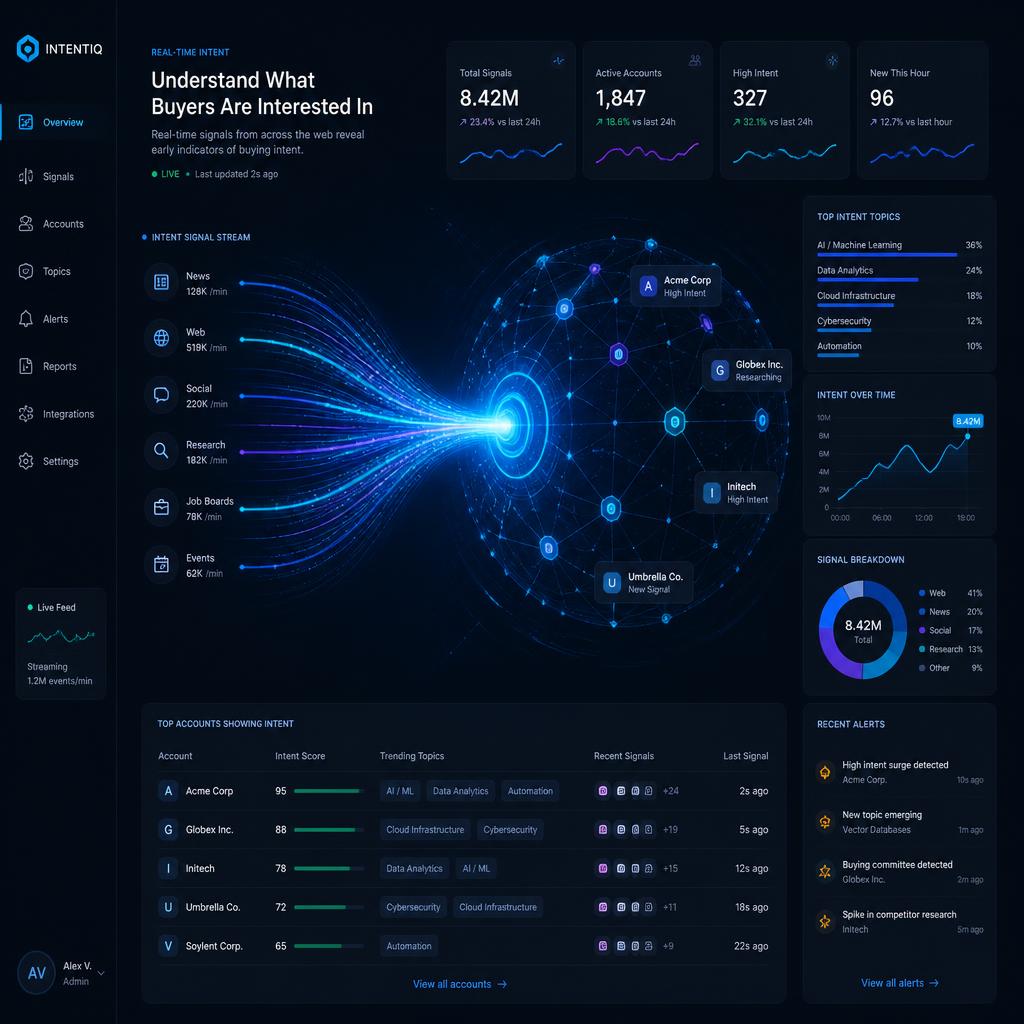
Intent signals are the behavioral breadcrumbs that reveal a buyer is moving toward a purchase — long before they fill out a form. Done right, they let revenue teams reach the right account at the right moment with a message that actually fits the situation. Done wrong, they become noise that fuels another generic sequence. This guide covers what intent signals are, the 14 highest-value types in 2026, how to source them, how to score them, and the exact playbook to convert them into pipeline.
What are intent signals?
An intent signal is any observable behavior — by a person or a company — that indicates active interest in a problem, category, or product. Signals can be first-party (happening on your owned properties) or third-party (happening across the open web, review sites, job boards, news, and communities).
The shift in 2026 is that signals are no longer just a marketing input. They drive sales prioritization, customer-success expansion plays, ad targeting, and product-led growth triggers. A modern revenue stack treats signals as the connective tissue between every go-to-market motion.
The key distinction: a lead tells you who raised their hand. A signal tells you who is about to.
Intent signals vs intent data: what's the difference?
Intent data is the aggregated dataset — usually purchased from a provider — that bundles signals across many sources into an account-level score. Intent signals are the individual events that feed that dataset.
Teams that only buy intent data often get a score with no story. Teams that work directly with signals know why an account spiked: a new VP of Engineering, a Series B announcement, a competitor renewal coming up. That context is what makes outreach land.
The 14 highest-value intent signals in 2026
Not every signal predicts revenue. After analyzing hundreds of thousands of closed-won deals across our customer base, these are the 14 that consistently correlate with pipeline:
- Job changes — a new decision-maker enters a target account or your champion lands at a new company.
- Hiring for adjacent roles — postings reveal budget, roadmap, and timing months before an RFP.
- Tech stack changes — a company rips out a competitor or adds an integration partner you support.
- Funding rounds — fresh capital plus a 60-90 day spending window.
- Executive changes — new CRO, CMO, or CFO almost always means a tooling review.
- Competitor research — your account is on G2, TrustRadius, or a comparison page for a competitor.
- Category research keywords — surges in branded and unbranded search at the account level.
- Website visits — repeat anonymous visits, especially to pricing and integrations pages.
- Content engagement — multiple stakeholders from one account opening the same email or webinar.
- Product usage triggers — for PLG: invite spikes, feature adoption, workspace expansion.
- Renewal timing — public contract data or signals that a competitor renewal is approaching.
- Press and news mentions — launches, layoffs, M&A, expansions into new geographies.
- Social and community activity — execs posting about a problem you solve; relevant Slack/Discord questions.
- RFP and procurement signals — public bid postings or vendor questionnaires hitting your category.
The single biggest mistake teams make: chasing one signal in isolation. The compounding effect of two or three signals from the same account in a 30-day window is where the real conversion lift lives.
Where to source intent signals
Signals come from four layers. A mature program pulls from all of them:
- First-party — your website analytics, product telemetry, email engagement, CRM events. Highest fidelity, narrowest reach.
- Public web — job boards, news, press releases, SEC filings, podcast appearances, company blog posts. Free, infinite, hard to process at scale without AI.
- Third-party providers — Bombora, G2 Buyer Intent, 6sense, ZoomInfo, and signal-intelligence platforms like Atomik. Pre-aggregated and account-resolved.
- Community and social — LinkedIn, X, Reddit, Slack communities, GitHub. Highest noise, but unmatched for early-stage signals and persona research.
The arbitrage opportunity in 2026 is the second layer. Public web data is enormous, free, and most teams can't process it manually — so AI-powered signal platforms surface it before competitors notice.
How to score intent signals (a simple model)
Not all signals deserve equal weight. Score each on three dimensions:
- Recency (1-5) — a signal from yesterday is worth 5x one from 90 days ago.
- Specificity (1-5) — "researching competitor pricing" beats "visited industry blog".
- Stakeholder fit (1-5) — does the signal involve someone in your ICP buying committee?
Multiply the three. Surface anything above 50 to the rep with full context. Below that threshold, hold it in a nurture lane — don't burn outbound attempts on weak signals.
The compounding rule: when two scored signals from the same account both clear 40 within 30 days, treat it as a tier-1 alert regardless of either score in isolation.
Turning intent signals into pipeline: the 5-step playbook
- Detect. Aggregate signals from all four layers into a single account view. The unit of work is the account, not the signal.
- Score. Apply the recency × specificity × fit model. Filter out noise before it reaches a human.
- Brief. Generate a 60-second context summary: what fired, why it matters, who the stakeholders are, what to say.
- Route. Send to the right channel based on signal type — owned-account reps for warm signals, BDRs for net-new, ads for late-funnel intent.
- Measure. Track signal-to-meeting and signal-to-pipeline rates per signal type. Kill the signals that don't convert; double down on the ones that do.
Teams running this playbook see 2-4x reply rates on outbound and 30-50% shorter time-to-meeting compared to lists built from firmographics alone.
Common mistakes to avoid
- Treating every signal as a green light. A signal is a reason to research the account, not a reason to send a template.
- Pushing raw signals into Slack with no context. Reps tune out alert fatigue within a week. Brief the signal or don't surface it.
- Optimizing for volume over fit. 200 generic signals get beaten by 20 high-fit signals every time.
- Ignoring the signal that didn't convert. Negative signals (unsubscribes, lost-comp deals, churn risk) are equally valuable feedback.
- Buying a data provider without changing the workflow. Signals only create pipeline when the team has a documented play for each signal type.
Frequently asked questions
What's the difference between intent signals and intent data?+
Intent signals are individual behavioral events (a job change, a pricing-page visit, a competitor review). Intent data is the aggregated dataset that bundles many signals into an account-level score, usually sold by providers like Bombora, G2, or 6sense. Signals are the inputs; intent data is one possible output.
Which intent signals are the most predictive of revenue?+
Across our customer base, the highest-converting signals in 2026 are: executive changes in the buying committee, competitor renewal timing, tech stack changes that imply integration fit, and repeat anonymous visits to pricing pages from a target account. Compounding signals (two or more within 30 days from the same account) outperform any single signal.
How do I collect intent signals without a third-party data provider?+
Start with first-party signals (website analytics, product usage, email engagement) and public web signals (job postings, funding announcements, press releases, executive moves on LinkedIn). AI summarization tools can process the public web at scale. Third-party providers add value once your in-house program is mature and you need account-resolved off-site research.
How quickly should sales act on an intent signal?+
Tier-1 signals (compounding, high-recency, ICP-fit) should be actioned within 24-48 hours — that's when the buyer is most engaged with the problem. Tier-2 signals belong in a weekly review cadence. Anything older than 30 days should be treated as context, not a trigger.
Do intent signals work for long enterprise sales cycles?+
Especially so. In a 6-12 month enterprise cycle, an early intent signal (new VP, competitor research, funding) gives reps months of runway to build relationships before procurement begins. The longer the cycle, the more valuable early signals become.
How do I avoid overwhelming reps with too many intent signals?+
Score every signal on recency, specificity, and stakeholder fit before it reaches a human. Only surface signals that clear a scoring threshold, and always attach a 60-second brief explaining what fired and what to say. Alert fatigue is the fastest way to kill a signal program.